

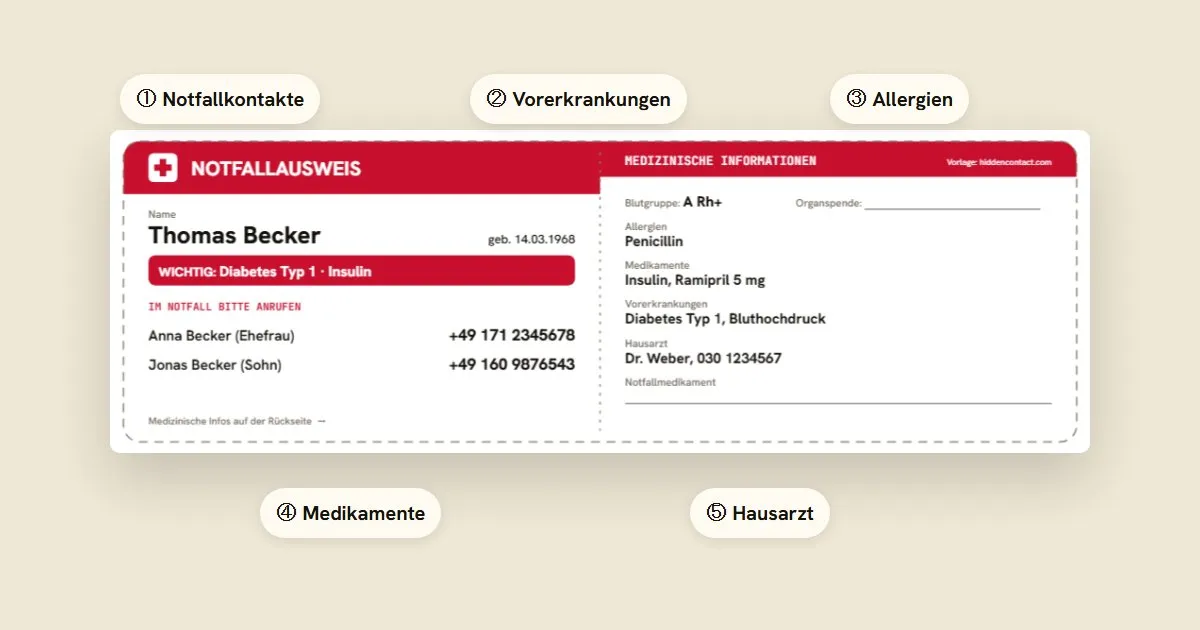
A medical alert card speaks for you when you can't: after an accident, during a hypo or an allergic reaction. For it to help at the crucial moment, the right things need to be on it, and in a way a stranger can take in within seconds. Here's the checklist, plus what to add for children, older people and medical conditions.
Name, date of birth, two emergency contacts, allergies, medication and conditions. The most important point, such as “type 1 diabetes” or “takes blood thinners”, goes at the top and stands out. With our printable medical alert card you can make one for free in credit card size.
The checklist: what belongs on every medical alert card
Personal details
- First and last name
- Date of birth: important for medication doses and to identify you clearly.
Emergency contacts
- Two people with their relationship and phone number, such as “partner” or “son”. Two, because one person may not be reachable in an emergency.
- With the country code if you travel abroad.
Medical details
- Allergies: especially to medicines such as penicillin or contrast agents, but also to insect stings, latex or nuts.
- Medication: blood thinners, insulin, heart medication and anti-epileptic drugs are particularly important.
- Conditions: such as diabetes, epilepsy, heart disease, asthma or kidney disease.
- Implants: for example a pacemaker, defibrillator or insulin pump.
- Blood type: optional, and only if you know it for sure. Hospitals test it again before any transfusion anyway.
Other notes
- GP with phone number.
- Organ donation: whether you're a registered donor.
- Advance decision: whether you have one and where it's kept.
- Other cards: a note about an allergy card, implant card or anticoagulation card if you have one.
A medical alert card isn't a medical report. Anything that doesn't matter for first aid only clutters the card. And leave out anything you're not sure about: wrong information is worse than none.
Medical alert card for children
In an emergency, children often can't say who their parents are or what they're allergic to. So the card should include:
- The child's name and date of birth.
- Phone numbers of both parents or another trusted adult.
- The paediatrician's name and phone number.
- Allergies, asthma, diabetes or epilepsy, clearly highlighted.
- If applicable: emergency medication such as an adrenaline auto-injector or asthma inhaler.
The card is best kept in the school bag or backpack. Because children like to leave their bags lying around, an emergency bracelet is the sturdier option. We explain why in our article on the emergency bracelet for children.

Emergency profile for children, no visible data
Kids SOS Bracelet | QR/NFC Emergency Profile
€11.90
Medical alert card for older people
- A full list of medication, or a note on where the medication plan is kept.
- Notes on dementia, hearing aids or poor eyesight, so helpers can judge the situation correctly.
- Contact details of relatives and, if applicable, the care service.
- Advance decision and lasting power of attorney: whether they exist and where they're kept.
For at home, some areas also offer an emergency information container kept in the fridge, such as the “Message in a Bottle” scheme in the UK, with a sticker on the front door telling paramedics it's there. For when you're out, the card in your wallet remains the right companion.
Medical alert card for medical conditions
With some conditions, the card decides whether helpers read a situation correctly:
- Diabetes: a hypo can look like drunkenness. A note like “Diabetes – if confused, give glucose if conscious” helps bystanders straight away.
- Epilepsy: a note on the condition and, if applicable, the emergency medication.
- Blood thinners: important for injuries and before any surgery.
- Severe allergies: name the trigger and whether you carry an adrenaline auto-injector.
A medical alert card doesn't replace cards issued by your doctor, such as an allergy card or implant card. It sums up the essentials at a glance and points to them.
How to make your medical alert card
With our free medical alert card generator you first choose who the card is for: yourself, a child, an older person or someone with a medical condition. The fields adapt to your choice, and the most important information appears highlighted on the front. Then you print the PDF, cut out the card and fold it to credit card size.
You should store the same information on your phone too. Our guide How to set up Medical ID on your phone shows you how.
Where paper falls short: the digital emergency profile
A card in a wallet is only found if someone looks for it, and it's out of date as soon as your medication changes. A digital emergency profile solves both.
A QR code on your watch, wristband, helmet or phone that's instantly recognisable as an emergency note. Helpers scan it without an app and see the emergency information you've chosen to share, or call your contacts. You update the details online without printing anything new.

Emergency profile on your watch or wristband
SOS Watch Strap | QR Emergency Profile
€11.90
For helmets, bikes or phone cases, see the SOS stickers and other emergency products.
Frequently asked questions
What must be on a medical alert card?
Name, date of birth, at least one emergency contact with a phone number, and all allergies, conditions and medication that matter for treatment. The most important point goes clearly at the top.
Should my blood type be on the card?
It can be, if you know it for sure. Hospitals always test the blood type themselves before a transfusion, though. Allergies, blood thinners and conditions matter more.
Where should I keep my medical alert card?
In your wallet, right next to your ID and health insurance card. That's usually where people look first. For children, it fits in the school bag.
How often should I update the card?
Whenever your medication, diagnoses or phone numbers change, and otherwise once a year. A date on the card shows how current the details are.
Does it replace an allergy card or implant card?
No. Cards issued by a doctor, such as an allergy card, implant card or anticoagulation card, contain details a medical alert card can't. The card sums up the essentials and can point to them.
What's the difference between a medical alert card and an emergency container in the fridge?
The card is for when you're out and sits in your wallet. An emergency container stays in the fridge at home and holds more detailed information for paramedics who come to your home. The two complement each other.


