

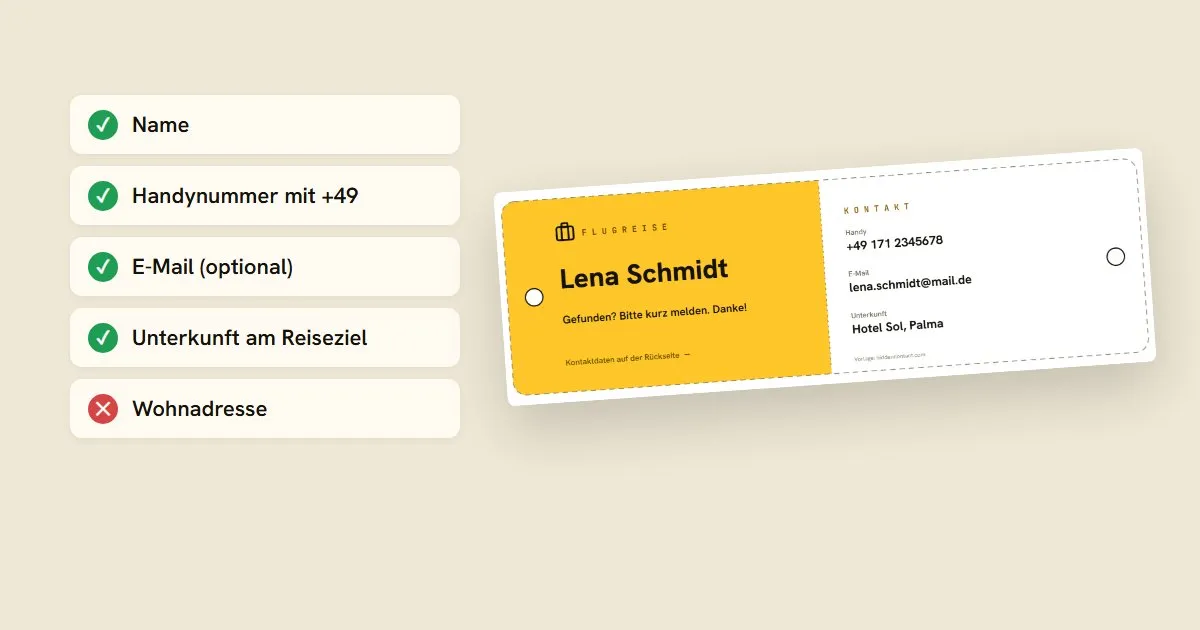
A luggage tag has exactly one job: if your suitcase gets lost, mixed up or left behind somewhere, it should find its way back to you. That takes surprisingly little text. Write too much, though, and you quickly give away more than you'd like. Here's the checklist, sorted by type of trip.
Outside: name, mobile number with country code, email optional. Your home address doesn't belong on the outside of the case, but on a note inside. For cruises add the ship and cabin, for school trips the number of the group leader. You can print matching tags for free with our luggage tag generator.
The basic rule: as little as possible, as much as necessary
Airlines, cruise lines and lost property offices only need one way to reach you. Anything beyond that can be read by everyone else at the baggage carousel too.
- Name: first and last name, as on your booking.
- Mobile number with country code: +44 7700 … instead of 07700 …, so an airline abroad can call you too.
- Email address: optional, but helpful if you're hard to reach abroad.
- Accommodation at your destination: optional. The hotel name or holiday address helps deliver a delayed suitcase directly.
What doesn't belong on the outside: your home address. Why that's a real burglary risk and what police and insurers say about it is explained in detail in our article Your address on a luggage tag.
Checklist by type of trip
Flights
- Name and mobile number with country code on the outside of the tag.
- On top inside the case: a note with your contact details, home address and itinerary. If the airline opens a case without a tag, they can still find you.
- Remove old barcode stickers from previous flights. They can cause mix-ups in automated sorting.
- Take a photo of your case and tag before you fly. It helps when reporting it missing.
Cruises
- Name, name of the ship, travel date and cabin number.
- Most cruise lines provide their own luggage tags, often to print with your travel documents. Always attach them, as they control delivery on board.
- Your own tag with your mobile number still makes sense in case the cruise line's tag gets lost on the way there or back.
School trips and group travel
- Name of the child or participant, class or group.
- Mobile number of the teacher or group leader, not just the parents'.
- Name of the accommodation, so mixed-up luggage quickly finds its way there.
Children's suitcases
- The child's first name is enough, plus a parent's mobile number.
- No home address and no full name with the school on the outside of the case.
- If the child travels with an allergy or a medical condition, an emergency card belongs in the hand luggage, not on the suitcase. You can make one with our printable medical alert card.
With our printable luggage tags you choose the type of trip and the generator shows the right fields automatically: for flights, cruises, groups or children. As a PDF, no sign-up, and your data stays in your browser.
How to make the tag survive the trip
On the baggage belt, tags get pulled, squashed and wet. Paper only survives that with a little help:
- Print on thicker paper, around 160 gsm, at 100% scale.
- Laminate it or cover it with clear self-adhesive film.
- Attach it with a cable tie or luggage strap, not a rubber band.
- Fix the tag to the handle, not to a zip pull.
The problem remains: everyone can read your number
Even a tag without an address shows your mobile number to everyone at the baggage carousel. For most trips that's an acceptable compromise. If you'd still rather not have your number on display, a digital tag is the answer.
Instead of plain text, the tag carries a QR code and an NFC chip. Whoever finds your suitcase scans it without an app and sends you a message that's forwarded to you anonymously. You decide which travel or return details are visible, and you can change them online for every trip without printing anything new.

Reachable without your number on the case
Digital Luggage Tag | NFC x QR
€11.90
A good combination: the digital tag stays on your suitcase permanently, and for individual trips you print an extra paper luggage tag when needed, for example for the cabin number on a cruise. More tags for keys, backpacks or bags are in our anti-loss products.
Frequently asked questions
What should be on a luggage tag?
Your name and a mobile number with country code, for example +44 instead of 0. An email address is a good addition. Nothing more is needed on the outside of the case.
Should I put my address on the luggage tag?
Better not your home address. It reveals that nobody is home right now. If you want to give an address, use your accommodation at the destination or put a note with your home address inside the case.
What do I write on a luggage tag for a cruise?
Name, ship, travel date and cabin number, so the crew can bring the case straight to your cabin. Many cruise lines send their own luggage tags with the travel documents, which you print and attach as well.
Do I need my own luggage tag if the airline prints a bag tag?
Yes. The airline's bag tag is only for sorting and often tears off along the way. Your own tag, plus a note with your contact details inside the case, is the backup for exactly that.
How do I make a paper luggage tag last?
Print it on thicker paper, laminate it or cover it with self-adhesive film, and attach it with a cable tie or luggage strap. A rubber band snaps quickly on the baggage belt.
What is a digital luggage tag?
A tag with a QR code and NFC instead of plain text. Whoever finds the case scans it and can contact you without your number or address being visible on the case. You decide which details are shown.


